Reading between the lines
By Garrett,
There’s a lot to learn in a professional services business between the day you open your doors and the day you sell or retire or whatever it is you do next. And there are a million different angles you can take to improve the future based on the past.
Here is a line graph of my previous business over an eleven-year period. It looks like I asked my four-year-old to draw a line (or the actual path from point A to point B in a client project) but bear with me.
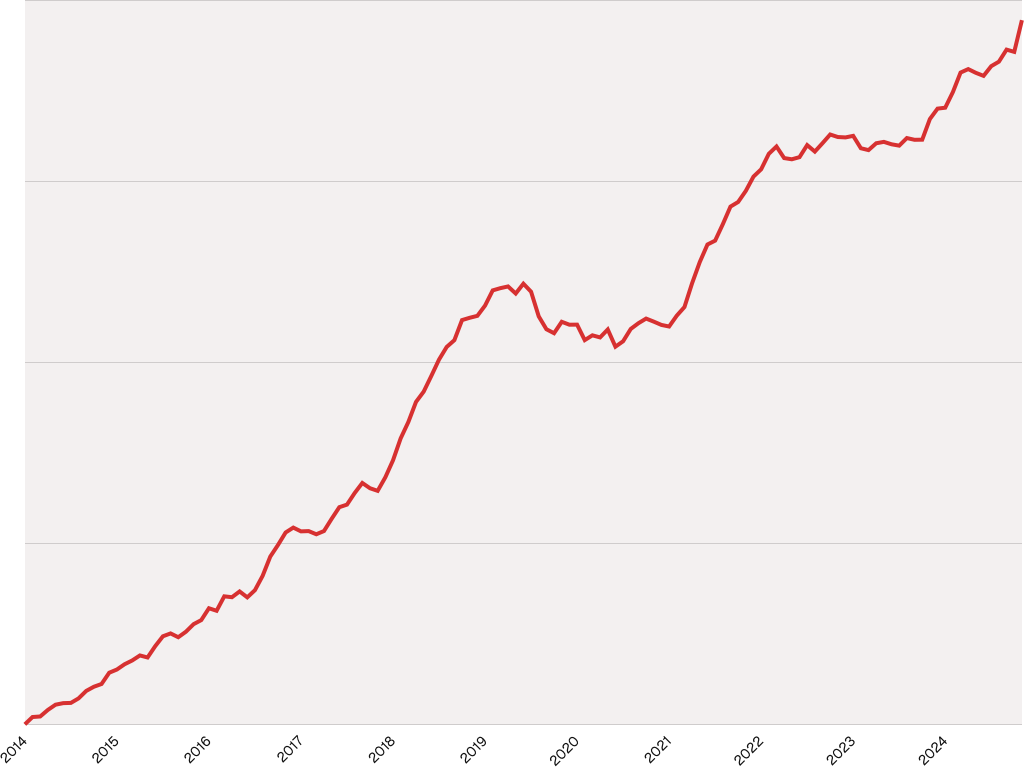
I can look at this graph and the dates and remember what I was doing at that time (and what was going on in the world at that time) and figure out what I did well, what I did badly and what was out of my control.
I could also slice that graph into a few growth categories or ranges, list out what had the most impact in one range and how those learnings transition into new insights for the next range. i.e. 0–$200k, $200k–$600k, $600k–$1.2m, $1.2m–$3m, etc.
In the earlier stages, shaping and packaging what makes you different, building consistency, and getting clear on your direction matter more than perfecting certain systems and processes. Over time, the systems and processes become more important, while still keeping a pulse on the others.
The point is, different principles matter at different stages and what’s critical in year one (or size one) might be irrelevant or need adjusting in year five (or size five), and vice versa.
And, sometimes you do stuff for a period and then forget about it in the next period. This exercise might help you to remember.
Overall, it’s a mix of consistency, positioning, process and making more good decisions than bad from the start that will smooth out the line and keep it moving up and to the right.
Pick 3-4 inflection points and ask yourself what you did well, what you’d change and what was simply beyond your control, and figure out how you can apply or evolve those insights to your business today.
Like this? Get email updates or grab the RSS feed.
More insights:
-
The trust problem that you already solved
Every developer who has spent time with AI coding tools carries the same low-grade anxiety. You ask the model to build something, it hands you back a file, and then you stare at it like a customs inspector wondering whether the suitcase has a false bottom. Line by line, function…
-
The flatness of the machine
You can feel it before you can name it. A paragraph arrives, fluent and frictionless, and something in the back of your reading brain flinches. The sentences are grammatically flawless, the structure orderly, the tone warm but not too warm, authoritative but not too authoritativ…
-
Software was never meant to last forever
There is a particular kind of frustration that anyone who has worked inside a mid-sized organisation will recognise. You are eighteen months into a Salesforce implementation. The original scope was clean and reasonable. But somewhere around month four, somebody realised that you…
-
The vibe coding spectrum: from weekend hacks to the dark factory
A year ago, Andrej Karpathy posted a tweet that would come to define how an entire industry talks about itself. “There’s a new kind of coding I call ‘vibe coding,’” he wrote, “where you fully give in to the vibes, embrace exponentials, and forget that the code even exists.” He d…
-
Claude Opus 4.6 just shipped agent teams. But can you trust them?
Anthropic shipped Claude Opus 4.6 this week. The headline features are strong: a 1M token context window (a first for Opus models), 128K output tokens, adaptive thinking that adjusts reasoning depth to the task, and top-of-the-table benchmark scores across coding, finance, and l…